Revolutionizing Resourcefulness on Mars
Pioneering a circular economy for humanity's next frontier. We turn mission waste into mission-critical assets at Jezero Crater.
Discover Our MissionThe 12,600 kg Problem
On a three-year Mars mission, an eight-person crew will generate approximately 12,600 kg of inorganic waste. Transporting resources from Earth is inefficient and expensive; bringing trash back is not an option. A sustainable, in-situ solution is not just beneficial—it's essential for long-term exploration.
"Future missions to Mars will need to manage inorganic waste generated from the crew’s daily operations with the goal of reusing and recycling as much as possible, and throwing away as little as possible."
 Do not try this on Mars! (in case you didn´t get the joke)
MISSION OBJECTIVES
A Circular Economy at Jezero Crater
Our primary objective is to design a sustainable system that manages, reuses, and recycles inorganic waste accumulated on Mars. The focus is on immediate, practical solutions for in-situ resource utilization, maximizing resource recovery while minimizing energy, water, and crew-time inputs, creating a foundational waste management infrastructure for all future planetary missions.
Key Mission Scenarios
Demonstrating Versatility in Recycling
Residence Renovations
Upon landing, the inflatable habitat's structural frame and extensive foam packaging become available. Our system reclaims these materials for immediate use.
Recyclable Elements:
- Aluminum structures & struts
- Polymer matrix composites
- Foam packaging (Zotek F30)
- Bubble wrap & air cushions
Cosmic Celebrations
For a crew member's birthday, party supplies are fabricated from common habitat waste, boosting morale without expending new resources.
Recyclable Elements:
- Clothing & textiles (cotton, nylon)
- Food & drink pouches (polyester, polyethylene)
- Plastic wraps and containers
- Disinfectant wipes
Daring Discoveries
After experiments to extract oxygen from CO2, surplus carbon and used lab equipment are processed into valuable new tools.
Recyclable Elements:
- Surplus carbon byproduct
- EVA waste (Nomex, polyester)
- Filters, mesh instruments
- Nitrile gloves & resealable bags
The M.A.R.C. System
Material Alchemy & Reclamation Cycle
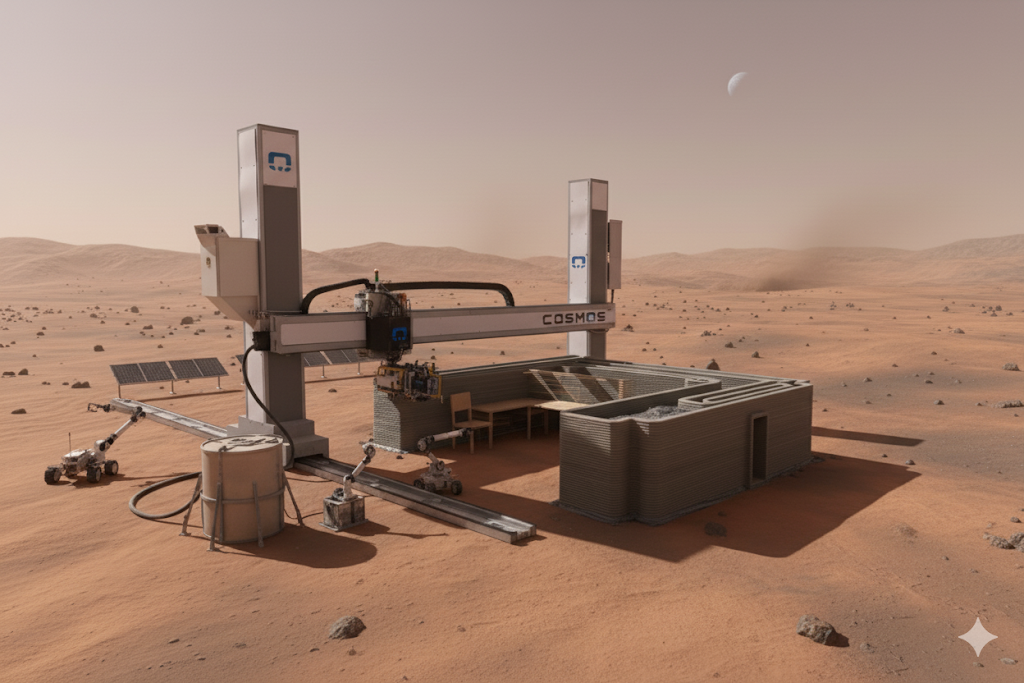
M.A.R.C. is a modular, automated system designed to transform diverse waste streams into high-value end products.
1. Automated Triage & Processing
Waste is sorted by material type. Fabrics are shredded, plastics are pelletized, and metals are separated for melting into fine powders.
2. Feedstock Synthesis
Processed materials are converted into standardized feedstocks. This includes creating polymer filaments for 3D printing, atomized metal powders for sintering, and weaving carbon byproduct into carbon fiber spools.
3. On-Demand Fabrication
A multi-material additive manufacturing unit (3D printer) creates complex parts, while a small-scale CNC mill shapes recycled aluminum blocks. End products can include utensils, storage containers, interior habitat fittings, small tools, and more.
Operational Parameters
System Constraints & Considerations
Resources & Location
- Base of Operations: Jezero Crater, Mars.
- Power: Continuous electricity available from habitat grid.
- Water: System designed for minimal water usage to preserve resources.
- Crew Time: Highly automated to minimize required operator hours.
Health & Safety Protocols
- No Incineration: All processing is done via mechanical or closed-loop thermal methods.
- No Toxic Emissions: System is fully contained to prevent harmful byproducts.
- Contaminant Avoidance: Processes are designed to avoid the creation of PFAS and microplastics.
- Regolith Integration: Capable of incorporating Martian regolith as a filler material for certain products.